How Does Riskonami Work?
Riskonami is designed to help you perform deep, structured risk assessments using AI — without sacrificing control, privacy, or long-term continuity.
At a high level, Riskonami combines:
- A structured, multi-phase risk methodology
- AI-assisted analysis using best-in-class models
- Long-term, GDPR-compliant context storage per assessment
1. Secure AI Architecture & Data Ownership
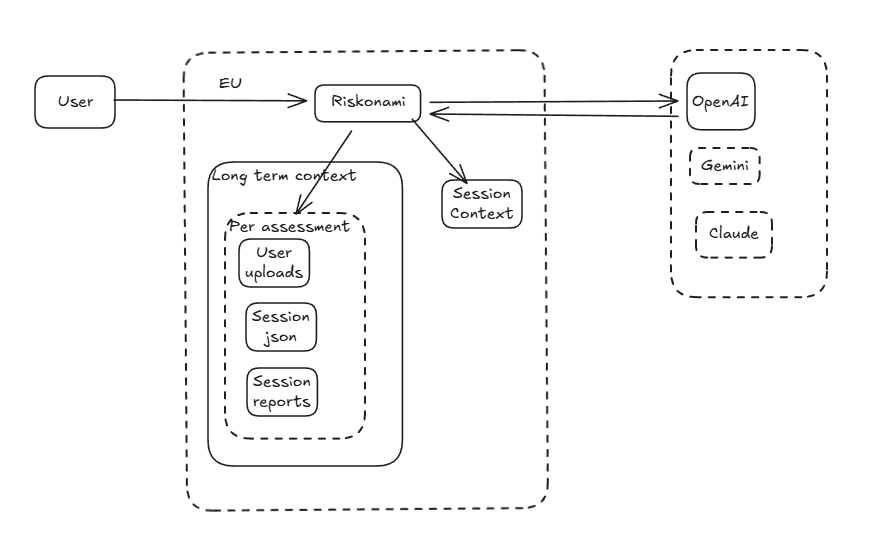
Riskonami acts as an intelligent layer between you and multiple AI models.
- We primarily use OpenAI, but the platform is designed to support multiple logical AI providers.
- AI models are used for reasoning and enrichment, not for long-term storage.
- All user input and uploads are collected and managed by Riskonami itself.
GDPR and EU Data Residency
- Session data and long-term assessment context are stored in the European Union.
- This ensures GDPR compliance and strict data residency guarantees.
- Data is isolated per customer and per assessment.
2. Session Context vs Long-Term Assessment Memory
Riskonami separates short-term interaction state from long-term assessment knowledge.
Session Context
- Maintains the current conversational and working state.
- Used to guide AI responses during an active session.
Long-Term Context (Per Assessment)
Each assessment has its own dedicated long-term context, which may include:
- User inputs
- Uploaded documents and evidence
- Structured JSON data from each phase
- Generated risk reports
There is no practical limit to the amount of context an assessment can retain.
As assessments evolve over time, Riskonami builds a deeper understanding of your system, environment, and risk posture — without needing to start from scratch.
3. A Structured, Multi-Phase Risk Process
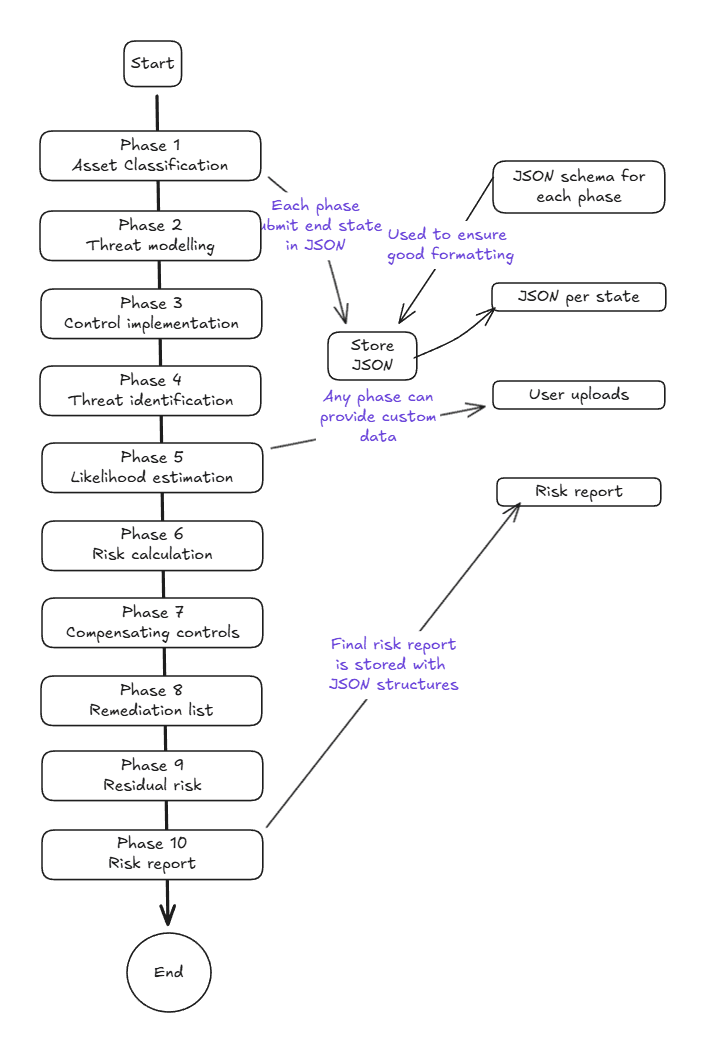
Every Riskonami assessment follows a clear, step-by-step methodology from start to finish.
The 10 Assessment Phases
- Asset Classification
- Threat Modelling
- Control Implementation
- Threat Identification
- Likelihood Estimation
- Risk Calculation
- Compensating Controls
- Remediation List
- Residual Risk
- Final Risk Report
Each phase is handled by a dedicated worker focused on a single responsibility.
4. Structured Data and JSON Schemas
At the end of every phase, Riskonami:
- Produces a JSON representation of the assessment state
- Validates it against a phase-specific JSON schema
Why This Matters
- Ensures consistent, high-quality data
- Prevents invalid or malformed inputs
- Keeps assessments machine-readable and auditable
Each phase produces a JSON-per-state, representing that phase’s outcome. Together, these states form the complete risk assessment.
Assessments can be:
- Paused and resumed
- Reloaded at any time
- Extended as systems and controls evolve
5. User Uploads and Evidence
At any point in the process, users can provide:
- Architecture diagrams
- Policies and procedures
- Technical documentation
- Supporting evidence
Uploads are:
- Stored locally in the EU
- Linked to the relevant assessment
- Referencable across all phases
This allows AI-assisted reasoning to be grounded in your real environment, not assumptions.
6. Final Risk Report and Traceability
The final output is a comprehensive risk report, generated directly from the structured assessment data.
- Reports are stored alongside their JSON structures
- Every conclusion is traceable to specific phases and inputs
- Future changes can trigger reassessment without restarting the process
This makes Riskonami suitable for:
- Continuous risk management
- Audits and compliance reviews
- Iterative security improvement
In Summary
Riskonami is not a one-off chatbot — it is a structured risk assessment system with memory and rigor.
- AI-assisted, not AI-owned
- GDPR-compliant by design
- Unlimited, per-assessment context
- Structured, auditable risk data
- Built for ongoing use, not single reports